
Most quality problems that end up as chargebacks and one-star reviews were visible in the factory before the carton ever got sealed. The seller just never saw the goods until they landed on a customer’s doorstep in Ohio or Manchester. By then, a bent zipper, a wrong-color trim, or a missing accessory is no longer a $2 fix — it is a refund, a return label, and a bad review that sits on your listing for months.
A qc inspection checklist china sourcing teams actually use is not complicated. It is a short, repeatable list checked against your product specifications before the shipment leaves the factory floor. This article lays out what that checklist should contain, when to inspect, what quality control costs to do properly, and where a private agent’s on-site QC desk earns its keep versus where a big-box dropshipping platform’s automated flow falls short.
Why factory-leaving quality checks matter more than QC at your door
By the time a defective shipment reaches your fulfillment center or your customer, you have already paid for production, freight, and duties named specifically — Section 301 and Section 122 among them. Catching a problem at the factory costs you an inspector’s day rate. Catching it after landing costs you the full landed cost of the goods plus return shipping, refunds, and the customer trust you cannot get back with a discount code.
Across the orders we pack every day, the pattern we keep seeing is simple: sellers who skip pre-shipment inspection on a new supplier see defect-driven returns run 8-15% on early batches. Sellers who inspect before dispatch, even with a basic checklist, typically bring that down to 1-3%. The math is not subtle — it is the difference between a supply chain that scales and one you have to unwind after two bad container loads.
The pre-shipment inspection checklist
This is the core checklist we run through before a shipment clears our warehouse. Adapt the specifics to your product category, but keep the structure — and keep it measured against fixed quality standards, not a factory’s verbal reassurance.
- Quantity check. Carton count against the packing list, and a sample carton opened to confirm unit count inside matches the label.
- Specification match. Color, size, material, and printed logo checked against the approved sample or spec sheet, not against the supplier’s memory of the order.
- Function test. For anything electronic or mechanical, a working sample from each carton lot, not just the master sample the factory kept aside.
- Visible defect scan. Scratches, stains, loose stitching, misaligned prints, cracked plastic — checked under normal light, not the factory’s best display lighting.
- Packaging and labeling. Barcode scans correctly, retail packaging matches the approved design, and any required country-of-origin or safety labeling is present.
- Accessory and manual completeness. Chargers, screws, instruction sheets, warranty cards — the small items that are easiest for a factory to under-pack.
- Sampling ratio (AQL). A statistically sound sample size, not “we checked a few boxes.” For most consumer goods, AQL 2.5 general inspection level II is the industry default.
Skip any one of these seven and you are trusting the factory’s own word for the parts of product quality most likely to go wrong. Factories are not lying to you on purpose most of the time — they are managing their own production pressure, and a rushed shift on a Friday before a holiday is when specification drift creeps in. This is exactly the gap a proper inspection service is built to close.
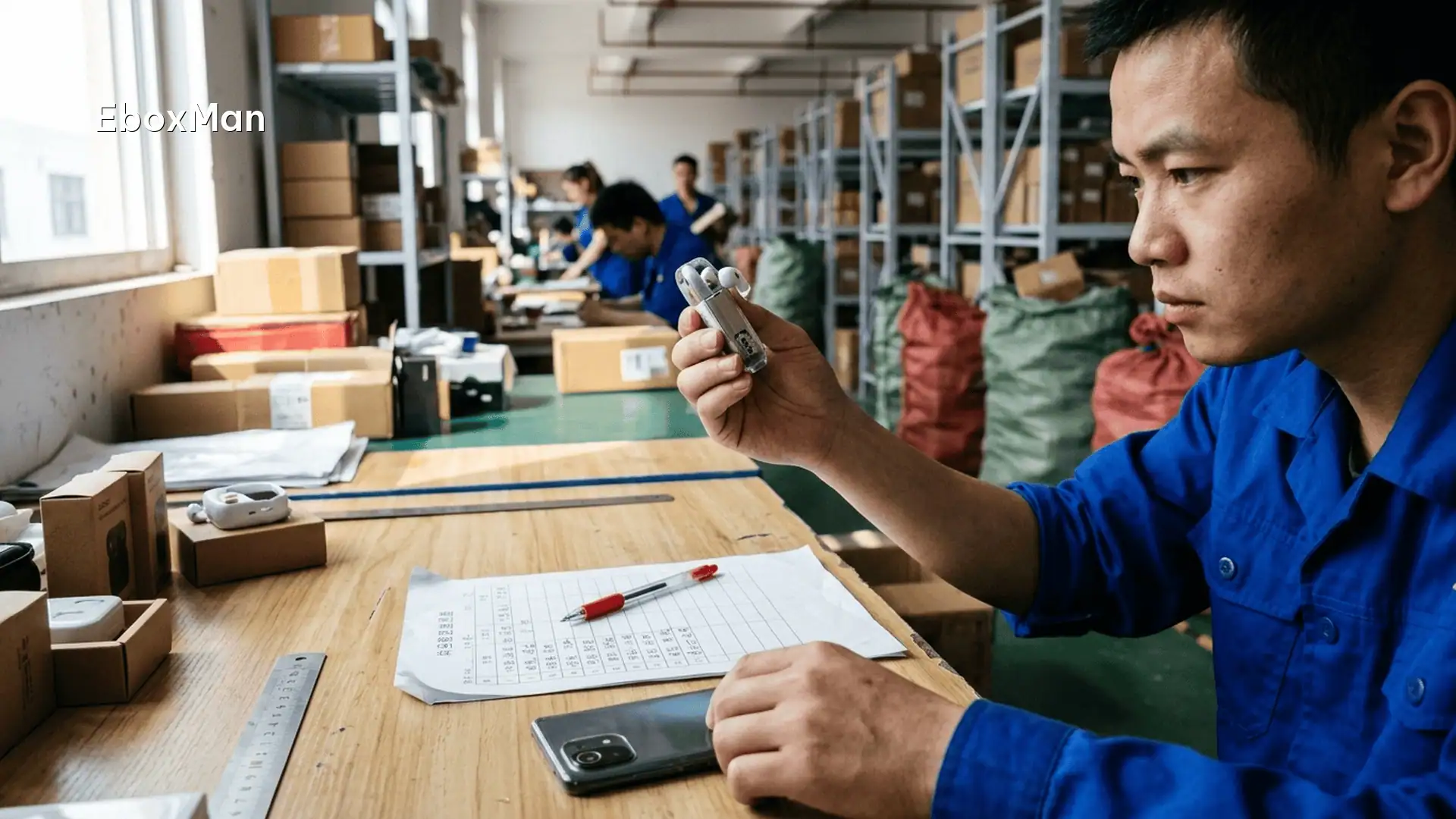
Who should do the inspection: you, an inspection company, or your agent
There are three realistic paths, and each has a real trade-off.
- Fly out yourself. Full control, zero translation loss, and a direct look at the factory floor. Also flights, hotels, and days off your actual business — usually only justified for large, high-risk, or first-time orders where you want to run your own factory audit.
- Hire a third-party inspection company. Firms like SGS, Bureau Veritas, or independent local inspection companies will send an inspector for a flat fee per man-day, typically $120-$280 depending on region and product complexity. Good for one-off audits or when you need an independent report for a buyer or insurer.
- Use your sourcing agent’s on-site QC. If your sourcing agent already has staff or a QC desk near the factory cluster, inspection is often folded into the service rather than billed as a separate inspection service line item, and the same team can act fast if a re-inspection is needed.
None of these is universally “better.” A one-time custom order from a brand-new supplier genuinely benefits from an independent third-party inspection report, because you want a neutral party’s name on the document. For recurring orders through an established supplier relationship, folding quality assurance into your agent’s existing process is usually faster and cheaper per shipment.
What pre-shipment inspection actually costs, compared
| Method | Typical cost per shipment | Turnaround | Best for |
|---|---|---|---|
| Self-inspection (you fly out) | $800-$2,500 (flights, hotel, time) | 2-5 days on-site | Large first orders, new factory relationships |
| Independent inspection company | $120-$280 per man-day | 1 day, report in 24-48h | One-off audits, buyer-required documentation |
| Agent-included QC desk | Often bundled into sourcing fee, no separate invoice | Same day as packing, photos before dispatch | Recurring orders, ongoing supplier management |
The number sellers usually skip in this comparison is what a missed defect costs after the fact: refund, return freight, and a customer who does not reorder. Weigh that against the inspection cost before deciding a product inspection line item is not worth it.
A shipment we see often: the reorder that goes sideways
A recurring pattern in our operations looks like this. A seller finds a new supplier for a private-label item, runs a first batch through with no inspection to save time, and the batch ships. Landed defect rate comes back around 10-12%, refunds eat 6-8% of that order’s revenue, and the seller is back to square one on where to source. When the same seller brings the reorder through a checklist-based inspection before dispatch — quantity, specification match, function test, packaging — defect rates on the next batch typically drop to 2-3%, and per-unit landed cost, once you include duties and freight, comes in more predictable because there is no re-shipping cost hiding in the average. Delivery timing does not change much either way; the inspection adds roughly a day, not a week.
If you want the tariff-inclusive number for your exact SKU, send it through our quote form — we reply within 24 hours.
How this connects to your landed cost and delivery
A clean pre-shipment inspection only pays off if the shipment then moves through customs without a separate bill showing up at your customer’s door. That is a shipping question, not just a quality question. Shipments moving DDP (delivered duty paid) clear formally with duties already settled, so a good batch of goods does not get stuck in customs limbo or hit with an unexpected charge that undoes the trust you just built with a clean product. We ship on lines that clear US customs formally, with duties paid before delivery and included in the per-unit price you quoted your customer — no surprise bill, no refused package.
Understanding your own landed cost, including Section 301 and Section 122 duties and any de minimis thresholds, is worth doing yourself even if an agent handles shipping. We do not classify HTS codes or file customs entries on your behalf — look up your product’s HTS code on the US ITC tariff database and run the math before you commit to a supplier price, so quality issues are not the only variable eating your margin.
Honest note: when a full inspection checklist is overkill, and where competitors do this well
Not every order needs a seven-point on-site inspection. Small reorders of an item you have sourced ten times from a proven supplier, low-value accessories under $2 a unit, or items where the factory has a three-year clean track record with you — these can run on a lighter spot-check without meaningfully raising your risk.
On the competitor side, platforms like CJdropshipping, Zendrop, and EPROLO have built genuinely useful catalogs with built-in supplier vetting for sellers who want to move fast on trending products without managing a factory relationship or running their own factory audits at all. That model works well for testing new products at low volume. Where a private agent’s inspection desk earns its cost is on repeat, higher-volume, or custom-branded orders, where you need someone checking your specification sheet against the actual carton, not a generic listing standard, and where fulfillment center handoff needs to be tight because you are shipping direct to end customers, not restocking a warehouse with slack time built in.
Building your own checklist template
If you manage sourcing without a dedicated QC partner, keep your specification sheet and inspection checklist in the same document your supplier signs off on before production starts. Include exact measurements with tolerance ranges, approved color codes (Pantone if it matters), material composition, and photos of the approved sample from multiple angles. When our QC desk photographs a batch before dispatch, we compare against exactly this kind of reference sheet — not a verbal description, not last season’s product. A checklist is only as good as the product specifications it is checked against, and quality standards mean nothing if nobody is holding the carton up to them.
Getting the tariff-inclusive quote before you commit
Quality control keeps your product right. Shipping and duties keep your price right. Both need to be settled before a shipment leaves the factory, not discovered after it lands. EboxMan has run this process since 2019, across 10,000+ orders a day, with QC photos taken before dispatch and one landed price that already includes Section 301 and Section 122 duties, so there is no bill waiting at your customer’s door. If you want a straight, tariff-inclusive quote for your product, send the details through our get a quote form — we reply within 24 hours.
Private Agent for Dropshipping Success