
Black Friday rarely breaks your store. It breaks the promises your store made at 9 a.m., when orders start arriving faster than your stock count, your delivery message, and your cash plan can absorb.
Whether your sale is already running or starts tomorrow, the decisions that protect your margin fall inside about 48 hours. This is a practical plan for black friday order surge fulfillment: what to tell customers, what each unit really earns, and how many orders to let in before quality slips.
Key takeaways
- 8-15 days is the honest order-to-doorstep window for China-shipped orders: 2-3 days processing plus 6-12 days shipping.
- Up to 40% of customs value can be added by Section 301 (25% on most goods) and Section 122 (15%), before the base duty rate. Check your margin per SKU now.
- A 30% discount on a $30 item leaves $21, and a $12 landed cost takes $9 of that before ads.
- Cap orders per day and per SKU. Wrong variants and missing parts are what a rush produces.
Why the surge breaks fulfillment before it breaks your ads
Across the orders we pack every day, the pattern we keep seeing is that sellers forecast traffic and ad spend carefully, then leave three things to chance. Those are the delivery window, the landed cost, and variant-level stock.
Ads scale in minutes, while order fulfillment scales in days. The gap between the two is where refunds, chargebacks, and angry emails come from during peak season.
Ads scale in minutes. Fulfilment scales in days. The gap between them is where your margin goes.
Hours 0-12: reset your delivery promise
Our processing time is 2-3 days after payment, and shipping runs 6-12 days door to door, with a US average of about 8 days. That puts the real window at 8-15 days from order to doorstep, before any carrier slowdowns that peak season can add.
Put that range on your product pages, cart, and confirmation email today. A customer who expects 10-14 days and gets 9 is happy, while one who expected 5 and gets 9 files a dispute.
| Order placed | Dispatch | Shipping | Arrival window |
|---|---|---|---|
| Black Friday (day 0) | Day 2-3 | 6-12 days | Day 8-15 |
| Saturday (day 1) | Day 3-4 | 6-12 days | Day 9-16 |
| Cyber Monday (day 3) | Day 5-6 | 6-12 days | Day 11-18 |
Watch out: Don’t advertise “arrives before the holidays” without doing the math. Take your last safe order date as the holiday date minus 15 days, then subtract extra buffer for carrier peaks, which nobody can promise away.
A delivery promise you can keep beats a fast one you can’t.
Hours 12-24: recheck margin after duties
The de minimis exemption is gone, so every China-to-US parcel needs formal customs entry, and your landed cost has to include the duties. Section 301 adds 25% on most goods (7.5% on List 4A items), Section 122 adds a 15% surcharge, and IEEPA duties may apply to some products on top of that.
You can look up your own HTS code in the USITC online tariff search and run the arithmetic yourself. On an $8 customs value with both surcharges, that’s $3.20 before the base rate. For edge cases, ask a licensed customs broker.
Now apply your Black Friday discount. A 30% cut on a $30 item leaves $21, and a $12 landed cost leaves $9 before ads and payment fees. If your cost to acquire a customer is $10, that sale loses money.
If you want the tariff-inclusive number for your exact SKU before you set Cyber Monday prices, send it through our quote form and we reply within 24 hours.
It also helps to know who pays at the door. We ship DDP on shipping lines that clear US customs formally, so duties are paid before delivery, included in your per-unit price, and your customer never gets a bill.
Discount against landed cost, not against product cost.
Hours 24-36: cap orders, freeze variants, keep QC
What a rush does to quality
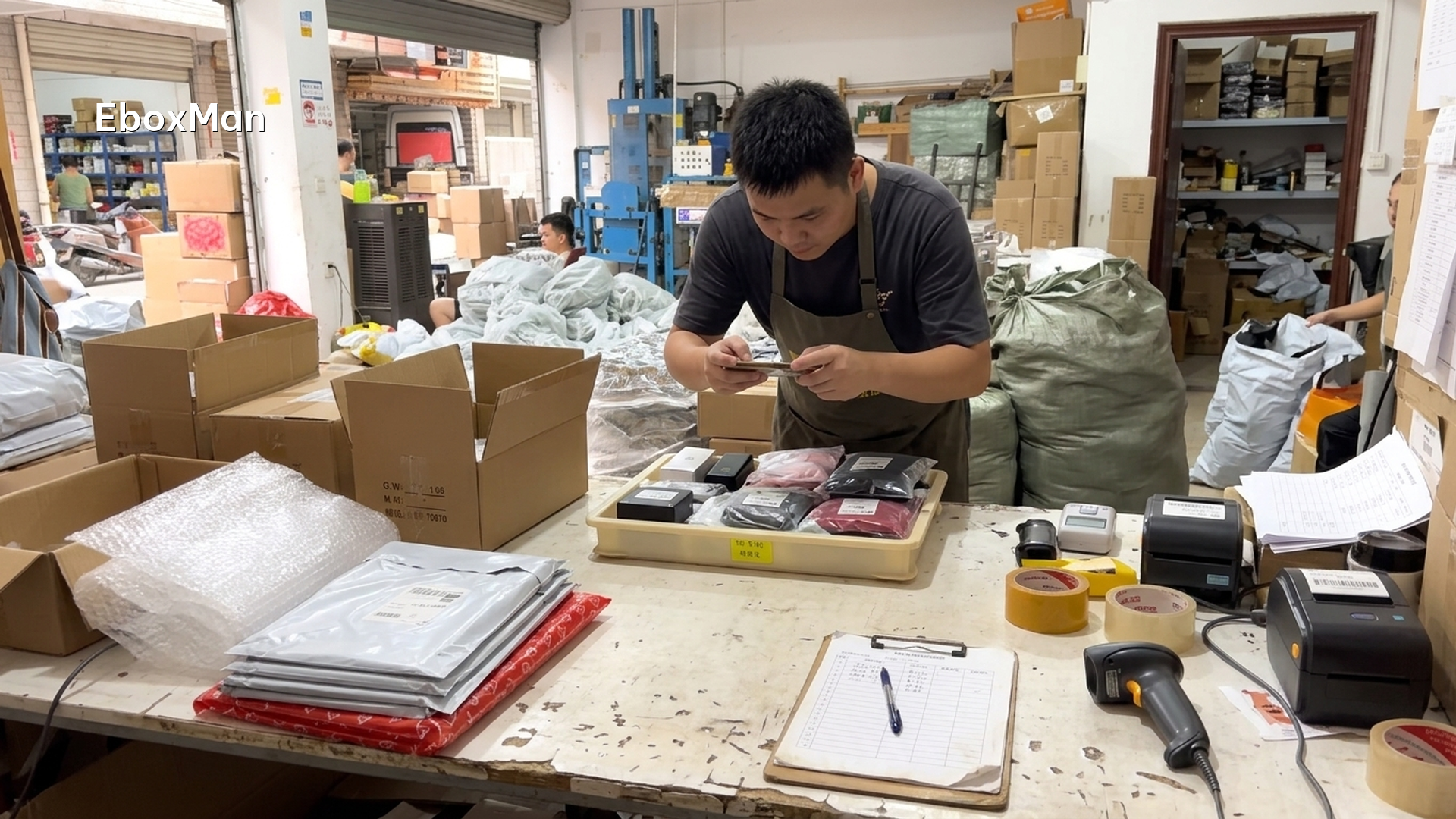
When our QC desk photographs a batch before dispatch, the problems we catch most in peak weeks are wrong colour variants, missing accessories, and crushed packaging. None are exotic, and all of them come from speed. At 10,000+ orders a day, we’ve learned that the checks you skip under pressure are the ones that come back as refunds.
Pro tip: Hide or cap any variant whose stock isn’t confirmed with the factory. Overselling one colour costs more in refunds than the sale earned.
A typical before and after
Picture a seller doing 80-120 orders a day who hits 300-400 during Black Friday week. The first year, they push every order to the factory in one unsorted stream, and wrong-variant and defect complaints land at 7-10% of orders. Delivery drifts to 11-18 days, and refunds eat about half the extra profit.
The next year they set a daily order cutoff, sell only confirmed-stock SKUs, and review batch photos before dispatch. Complaints fall to roughly 3-4%, and delivery lands at 9-12 days.
A daily cutoff and a photo check cost you a few hours. Skipping them costs you a week of refunds.

Hours 36-48: set up Cyber Monday and customer comms
By hour 36 you have real data on what sold, what ran out, and what your delivery messaging is doing to support tickets. Use it to build a Cyber Monday offer from products with confirmed stock and positive post-duty margin, and run this checklist before you launch it:
- Publish a daily order cutoff on your shipping page.
- Cap or hide SKUs with unconfirmed stock, variant by variant.
- Send a confirmation email that states “ships in 2-3 days, arrives in 8-15.”
- Confirm tracking numbers sync to your store in real time.
- Decide your reship-or-refund rule now, not when the tickets arrive.
- Re-run margin per SKU with the Cyber Monday discount applied.
Customers forgive a long delivery window. They don’t forgive one nobody told them about.
When an agent doesn’t make sense, and when the math works
Marketplace platforms and shared-warehouse suppliers have real strengths: instant listing, no negotiation, and low effort at small volume. Under roughly 10 orders a day, they’re often the better fit, and a sourcing agent may not pay for itself.
The common objection at higher volume is that an agent adds margin on top. Take 1,000 peak orders at a 7-10% problem rate versus 3-4%, which is about 40-60 fewer problem orders. At $12-$35 each in refunds or reships, that’s roughly $500-$2,000 per 1,000 orders before you count support time.
If an agent’s margin on those 1,000 orders is below that figure, it pays for itself. If it’s above, stay with a platform.
An agent earns its margin only if it removes more refunds than it costs.
Frequently asked questions
Can I still source stock from China if the sale is already live?
Yes, but stock won’t arrive this week. Processing plus shipping means 8-15 days from payment, so sell with an accurate window or run a clearly labeled preorder.
What delivery time should I promise customers?
For China-shipped orders, promise 8-15 days and add buffer for carrier peaks. The US average is about 8 days of shipping, but a promise should cover your slower orders, not your average one.
Do duties change on Cyber Monday?
No. Section 301 and Section 122 apply on the same terms regardless of promotions, and IEEPA duties may add to them depending on the product. Check your HTS code yourself, and ask a licensed customs broker about edge cases.
Is ordering a sample worth it right now?
Sample orders are supported with no minimum, but they take the same 8-15 days. Order one to vet a product for January rather than to rescue this weekend.
Black Friday rewards sellers who decide their limits early: how many orders, which SKUs, and what margin. If you’d like a tariff-inclusive number for the products you plan to push into Cyber Monday and beyond, send them through our free sourcing quote and we’ll reply within 24 hours.
Private Agent for Dropshipping Success